


THE PROJECT
The Challenge : Social Housing and Innovation
Social housing in Brussels concentrates a young and diverse population with strong entrepreneurial and creative potential. Yet, infrastructure dedicated to professional support, social innovation, and project incubation remains scarce. Residents, as well as sector professionals (architects, urban planners, social workers), lack accessible spaces for meeting, collaboration, and experimentation.
Faced with this reality, the SLRB mandated Creative District to design a solution capable of transforming an underused building into a genuine innovation laboratory. Creative District therefore developed the concept of a hub where social housing stakeholders, social entrepreneurs, architecture and urban planning professionals, and residents can come together to co-create sustainable and inclusive solutions that respond to the needs of their neighborhoods.
The Opportunity : A Societal Innovation Ecosystem
Innovation 4 Society is part of an urban and social transformation dynamic. By bringing together in one place organizations with complementary skills – participatory real estate development (CLTB), inclusive housing (Angela D., Habitat & Participation), homelessness prevention (L’Ilot, Escale), sustainable and participatory architecture (Alive Architecture, Up! Architecture, PHDV, Taktyk) – the project creates fertile ground for collective innovation.
Beyond simple coworking, Innovation 4 Society becomes a place for dialogue, experimentation, and knowledge co-production around housing, sustainable urbanism, and active citizenship issues.
Project Objectives
Innovation 4 Society is not simply a coworking space. It is a societal innovation laboratory where Creative District activates its field expertise to transform social housing into catalysts for creativity and entrepreneurship.
The 3,500 m² physical space serves as a proof of concept to demonstrate that a diverse ecosystem of social housing actors can co-create innovative solutions when provided with a structured and facilitated collaboration framework.
1. Create a Collaborative Innovation Ecosystem
Our primary objective is to bring together and facilitate a network of complementary actors – participatory real estate developers, committed architects, social support structures, social entrepreneurs – to foster the emergence of innovative projects through strategic networking and co-creation.
Target impact: Spontaneous collaborations between organizations, collective responses to project calls, and the emergence of new working methodologies in the social housing sector.
2. Experiment and Document Participatory Approaches
Innovation 4 Society is an experimentation ground where Creative District tests, refines, and documents citizen participation methodologies, co-design, and open innovation in the specific context of social housing.
Added value: Each project (anti-discrimination, talent recognition, ecological transition) becomes a case study enabling the capitalization of learnings transferable to other territories and contexts.
3. Connect Public Policy and Field Realities
By working directly with both social housing residents AND institutional decision-makers (SLRB, SISP), Creative District fulfills its role as “Honest Broker”: translating field needs into policy recommendations, and conversely adapting institutional programs to lived realities.
Strategic positioning: Innovation 4 Society becomes a bridge between “bottom-up” (residents’ and field professionals’ needs) and “top-down” (social housing public policies), enabling constructive dialogue and better-informed decisions.
4. Strengthen Sector Actors’ Capacities
Through trainings, thematic workshops, and individualized support, Creative District contributes to skill development of hosted organizations and sector professionals (project management, fundraising, impact communication, participatory methodologies).
Capacity-building approach: Rather than simply providing offices, we invest in strengthening organizational capacities so each actor can maximize their social impact.
5. Demonstrate Viability of a Replicable Model
Innovation 4 Society serves as a demonstrator: proving that a hybrid model (infrastructure management + community facilitation + action research) can be economically viable and socially impactful, with the ambition to replicate it in other urban contexts.
Long-term vision: Document the model sufficiently (methodologies, results, costs, success factors) so it can be adapted and replicated by other cities, regions or countries facing similar social housing innovation challenges.
The Innovation 4 Society Model:
Facilitation + Research + Animation
Creative District developed for Innovation 4 Society an operational model with three complementary dimensions:
1. Community Animation and Network Facilitation
Beyond providing physical space, Creative District actively animates the occupant community through:
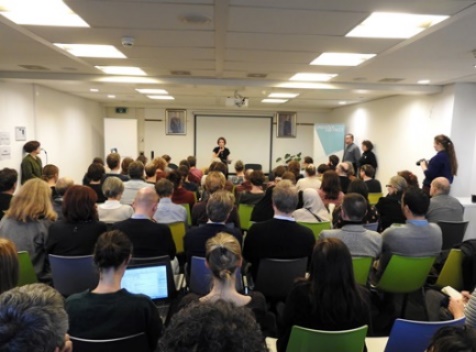
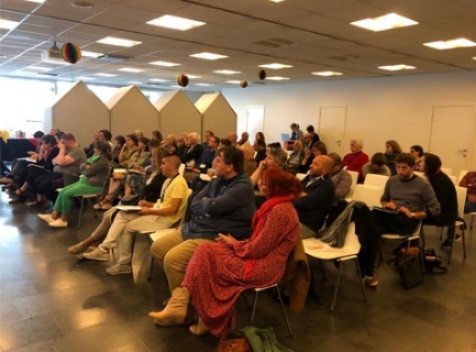
- Organization of monthly thematic events (15+ per year) creating meeting and exchange opportunities
- Facilitation of strategic connections between complementary organizations
- Support for emerging collaborative projects (collective responses to calls, etc.)
- Creation of community rituals (afterworks, thematic meals, collective soups)
2. Action Research and Documentation
Each Innovation 4 Society initiative is designed as an action research project:
- Initial hypotheses: What are we testing? (e.g., does co-creation reduce perceived discrimination?)
- Explicit methodology: Participatory workshops, qualitative data collection, satisfaction measurement
- Rigorous documentation: Production of deliverables (brochures, reports) capitalizing learnings
- Results dissemination: Sharing with SLRB, other territories, and European networks
3. Bottom-Up ↔ Top-Down Facilitation
Innovation 4 Society enables continuous dialogue between two usually siloed levels:
- Bottom-up (field → policy): Escalating field needs, constraints and innovations to SLRB/SISP decision-makers
- Top-down (policy → field): Testing and adapting institutional programs with actors and residents
- Creative District role: Translator and mediator between these two logics, ensuring each side understands the other’s constraints
Examples of Co-Produced Projects (Action Research)
“See 1 Neighbor / Gluren bij de buren” (Anti-Discrimination)
Objective: Understand and reduce perceived discrimination in social housing through encounter and dialogue
Methodology: Participatory expression workshops, testimony collection, co-construction of 8 concrete action axes
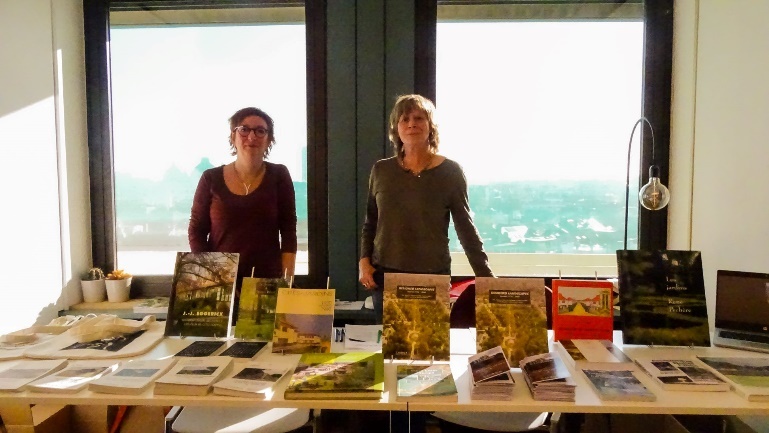
Deliverable: Brochure documenting methodology, testimonies, theoretical concepts and action plans
“Tomorrow’s Talents are Built in Today’s Housing”
Objective: Showcase skills present in social housing by highlighting role models
Approach: Communication campaign designed by youth, giving voice to inspiring residents and workers
Impact: Narrative shift around social housing, from “problem” to “potential”
IMPACT
Qualitative Impact: What 4 Years of Experimentation Reveal
1. Emergence of Unlikely Collaborations
Active network facilitation generated collaborations that mere physical proximity would not have created: architecture firms partnering on project calls, social structures pooling their expertise, action-research projects co-built between actors who would never have met otherwise.
Concrete example: 5 architecorganisations spontaneously created a collective to respond together to participatory housing calls
2. Documented and Transferable Methodologies
Action research projects produced deliverables documenting not only results, but also methodologies used, difficulties encountered, and learnings – enabling replication in other contexts.
Value for Creative District: These documented methodologies reinforce Creative District’s consulting credibility with other territories seeking to innovate in social housing.
3. Effective Bottom-Up ↔ Top-Down Dialogue
Innovation 4 Society created continuous dialogue channels between SLRB and field actors, enabling SLRB to adjust programs based on real feedback, and organizations to better understand institutional constraints.
Result: Better-informed public policies, and field actors better prepared to collaborate with institutions.
4. Institutional Recognition and Visibility
Innovation 4 Society became a reference hub for social housing and urban innovation actors in Brussels, hosting institutional visits, international delegations, and being featured in documentaries on social innovation.
LESSONS LEARNED AND BEST PRACTICES
What Experimentation Confirms
- Facilitation is determinant: Mere physical proximity is insufficient. Monthly events, active networking and facilitated projects create collaborative value.
- Occupant selection is strategic: Choosing organizations sharing common values (participation, innovation, social commitment) drastically reduces friction and accelerates synergies.
- Systematic documentation pays off: Each documented project becomes a reusable asset to convince new partners, train other territories, and strengthen consulting expertise.
- The “translator” role is crucial: Translating between institutional language (policies, KPIs, calls) and field language (real needs, operational constraints) creates unique value.
Identified Structural Challenges
- Financing the intangible: Funders easily finance real estate, but rarely facilitation, animation and action research – yet essential to value creation.
- Qualitative impact measurement: Main impact (emerging collaboration, practice changes, reinforced dialogue) is qualitative and thus harder to quantify for institutional reports.
- Precarious human resources: Relying on internships and precarious jobs weakens facilitation continuity and quality – a more stable economic model is needed.
Recommendations for Replication
- Secure facilitation funding: Explicitly budget the ecosystem facilitator function, beyond real estate management
- Co-build from the start: Involve future occupants in model design to ensure needs-offer fit
- Document continuously: Integrate documentation as part of the model, not as optional activity
- Plan conviviality spaces: Cafeteria, modular rooms, informal spaces are essential for spontaneous encounters
PARTNERS AND FUNDERS